
Augusta Neighbors Block Sources
A block search answers several small questions, not one broad question. Augusta Maps identifies the lots that touch or sit near an address. Assessor cards name the indexed owners and separate the physical situs from the tax mailing address. Georgia voter files can add registered names by address through a controlled order process. Historical reverse directories show listed occupants for some years, while civic groups describe neighborhood coverage without exposing private members.
| Official or Local Source | Block Evidence | How to Access It |
|---|---|---|
| Augusta Maps parcels | Boundaries, selected property cards, ZIP and district context | Free map viewer |
| Assessor cards | Owner, mailing address, situs, parcel, and property facts | Free through selected parcels |
| Standard Georgia voter list | Registered names and address fields sortable by street | Paid state order with legal limits |
| Historical reverse directory | Listed occupant or business at an address | Georgia Heritage Room, volume dependent |
| Neighborhood association | Public officers, contact points, and civic area | Published organization channels |
Each record proves only its own fact. An owner may live elsewhere. A registered voter does not represent everyone in a home. An association officer is a public civic contact, not a key to the group's membership. That distinction keeps an Augusta neighbors search accurate.
Map Augusta Neighbors by Parcel
The most reliable block process begins with a parcel polygon, the outlined lot on the county map. Search the subject address in Augusta Maps, select that lot, and record its parcel number. Keep the parcel layer visible as the search moves outward.
- Find the exact address and click its parcel. Save the situs, parcel number, and indexed owner.
- Pan and zoom. Click each lot that touches the subject parcel, then the closest lots across the street.
- Record each owner's mailing address separately. A matching mailing and situs address may support occupancy but does not prove a full household.
- Add a ZIP, neighborhood, historic district, or boundary layer only after the parcel list is clear.
- For every parcel along the named road, switch to the Augusta street directory workflow.
A parcel ID is safer than a name when two owners share a surname. It also lets the researcher return to the same lot after the map view changes.
Augusta Radius Tools Need Care
The Augusta Maps sales-search panel documents circular-radius and drawn-polygon modes. Those tools compare properties inside an area. They do not produce a household-radius report. Filters may include property type, improvement type, neighborhood, structure size, basement size, and a map-view choice. Use them to understand nearby sales or building patterns, then click individual parcels for the official card.
A wide radius can cross a major road, neighborhood line, municipal edge, or the Richmond County boundary. Start small. Keep a short worksheet with parcel ID, situs, owner role, mailing address, retrieval date, and any chosen layer. This prevents a map selection from becoming an unsupported claim about your Augusta neighbors.
Note: A map radius groups land by distance; it does not establish a social block, household, or neighborhood membership.
Layer Augusta Block Geography
The official Augusta GIS legend confirms layers for ZIP codes, neighborhoods, census blocks, block groups, tracts, historic districts, old city limits, municipal boundaries, and the Richmond County line. Add one or two at a time. Too many shaded layers can hide parcel lines and lead to bad clicks.
- Situs address
- The physical address assigned to the parcel.
- Mailing address
- The destination for tax notices, which may not be the owner's home.
- Census block
- A small statistical area. It describes geography, not named people.
- Historic district
- A preservation boundary that adds building context but no resident roster.
ZIP layers answer mail geography. Municipal and county lines answer jurisdiction. Police, fire, marshal, and commission districts show service or political geography, not identity. Old City Limits can help explain why an older Augusta roll covers only part of a present-day block.
Augusta Neighbors and Voter Data
Georgia's My Voter Page verifies one voter after a first initial, last name, county, and date of birth are entered. It cannot browse an Augusta street. The lawful block-level channel is the standardized voter-list order administered by the Secretary of State. A countywide Richmond list costs $70 under the 2024 schedule and may be sorted by residence fields. Custom orders are not offered.
| Method | Best Use | Key Limit |
|---|---|---|
| My Voter Page | Verify one known registration | Identity inputs required; no street browsing |
| State voter-list order | Lawful street or block sorting | Paid, standardized file; no custom orders |
| VoteSafe | Protect a qualifying residence address | Protected address remains concealed |
Voter participation shows that a person took part in an election, never how the person voted. Georgia does not register voters by party. Social Security numbers, driver-license numbers, and full birth dates are not general public list data. A voter entry is registration evidence, not a complete household list.
Augusta Neighborhood Contacts
Planning documents name civic groups across Augusta and Richmond County. These associations can explain boundaries, meetings, projects, and public concerns. They do not prove who lives at each address, and no official source reviewed promised a public member directory. Contact only through channels the organization or city has published.
Historic Core
Olde Town and East Augusta groups cover distinct east-side civic areas; Augusta Tomorrow works on downtown development.
Central and West
Summerville Neighborhood Association, West Augusta Alliance, Harrisburg-West End, Sand Hills, and Sandridge Community appear in official planning material.
South and Renewal Areas
Laney Walker-Bethlehem, Heritage Pine, Turpin Hill, and Richmond County Neighborhood Alliance provide named civic reference points.
Published officers can be contacted in their civic roles. Closed rosters, member emails, and household lists remain private. Congregations and other community groups may preserve history, but their rolls are not substitutes for official property or voter records.
Official Augusta Rolls Compare Better
Commercial neighbor tools often merge old addresses, phone data, and names from unclear dates. Official sources are narrower, but their keeper, date, and meaning are visible. That makes them easier to correct and safer to interpret. Use the official record that matches the question, then confirm any important fact with a second source.
| Choice | Strength | Weakness |
|---|---|---|
| Augusta parcel and tax records | Current parcel identity and indexed owner | Owner is not always an occupant |
| Georgia voter records | Dated registration and election geography | Not every resident is registered or visible |
| Commercial category | May combine many broad clues | Source dates, roles, and correction paths may be unclear |
The right comparison is not which source returns the most names. It is which record can support the exact Augusta block fact being stated.
Augusta Safety Records Are Separate
Public safety tools answer a narrow status question. The Richmond Sheriff inmate inquiry concerns current custody and booking data. It does not prove residence. The Georgia Sex Offender Registry supports the statutory safety purpose and includes its own accuracy warnings. Court disposition and address status should be verified with the proper keeper.
Review the Richmond inmate inquiry source before treating a booking address as neighborhood evidence.
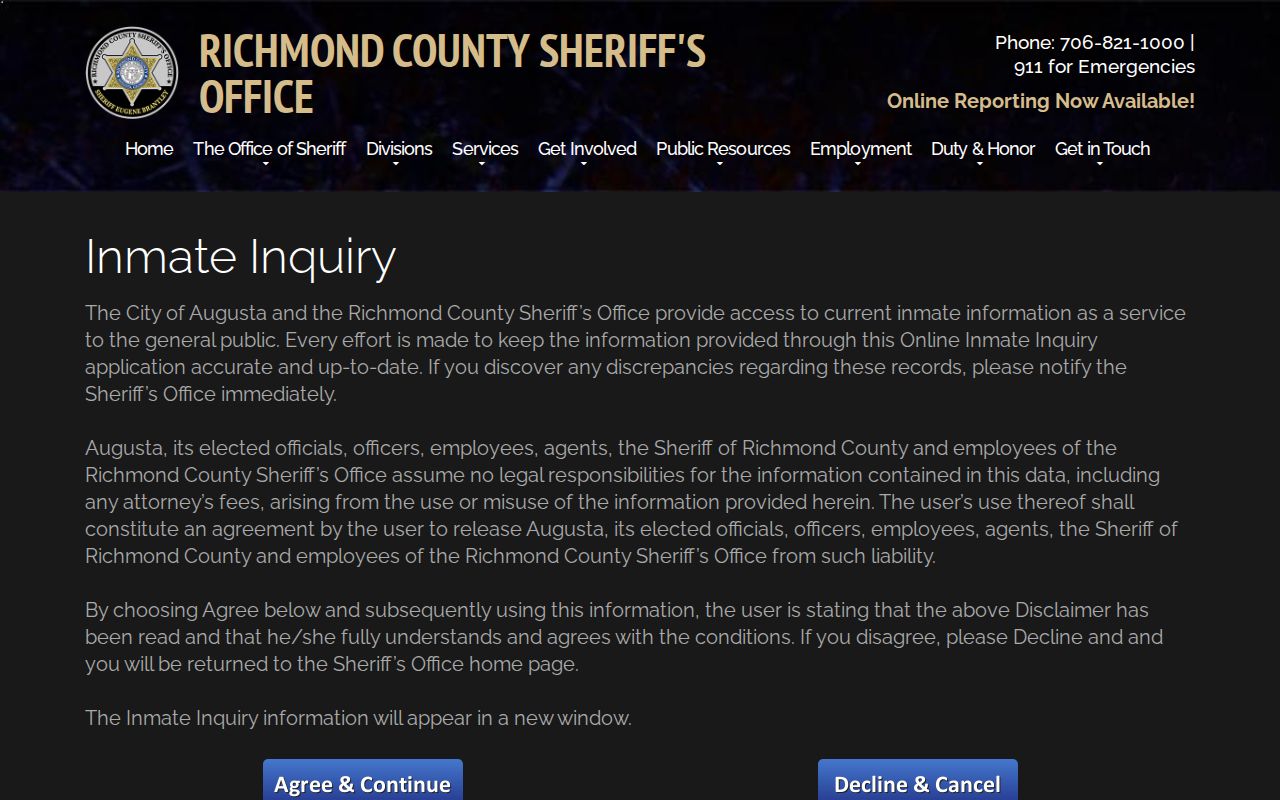
The screenshot shows a separate custody channel, not an Augusta neighbors or parcel directory.
Privacy Limits for Augusta Neighbors
Parcel cards do not list children, relatives, guests, or all renters. Utility and delivery records are not public block directories. Georgia's VoteSafe program shields qualifying voter addresses, and other laws protect driver data and sensitive identifiers. Historic reverse directories cover only those printed in a volume, not every adult who lived nearby.
Respect those gaps. Do not merge a tax owner, voter, association officer, and booking record into a single profile unless each dated source clearly refers to the same person. Contact a record custodian to correct official data. Use public civic channels when the goal is to meet a group or ask about the block.
Lawful use. Look up Augusta neighbors for civic curiosity, reconnecting, or personal safety. Never watch, intimidate, harass, or expose a protected person.