
Augusta Directory Collections and Access
Augusta's surviving directory record starts in 1841 and continues to the present with gaps. The Georgia Heritage Room holds the broad local run, with fragile early books served on microfilm and roughly the latest 65 years reported in book form. Reese Library at Augusta University and the Augusta Genealogical Society also hold originals, copies, and indexes. The shelf is therefore shared across institutions, not confined to one database.
| Collection | Years represented | Where held | Access |
|---|---|---|---|
| Augusta city directories | 1841 to present, with gaps | Georgia Heritage Room, Reese Library, AGS | Early microfilm, later books, onsite use |
| Personal-name indexes | 1841 to 1902 | ARCPLS and AGS | Published index, then full volume |
| Business indexes | 1841 to 1930 | ARCPLS and AGS | Search by trade, owner, or manager |
| Telephone directories, MS 181 | Volume-dependent | Georgia Room Special Collections | Onsite; reverse use depends on arrangement |
| Pughe's directories, MS 188 | Collection-specific | Georgia Room Special Collections | Special-collection access |
| Augusta Chronicle | 1792 to present | ARCPLS archive and microfilm | Remote for eligible local cardholders; onsite microfilm |
Missing editions matter. The documented early sequence is sparse, and publication dates are snapshots rather than proof of continuous residence. A year with no book should be bridged with census, newspaper, deed, church, school, or funeral evidence.
The ARCPLS Augusta directory holdings article presents the local collection shown below.
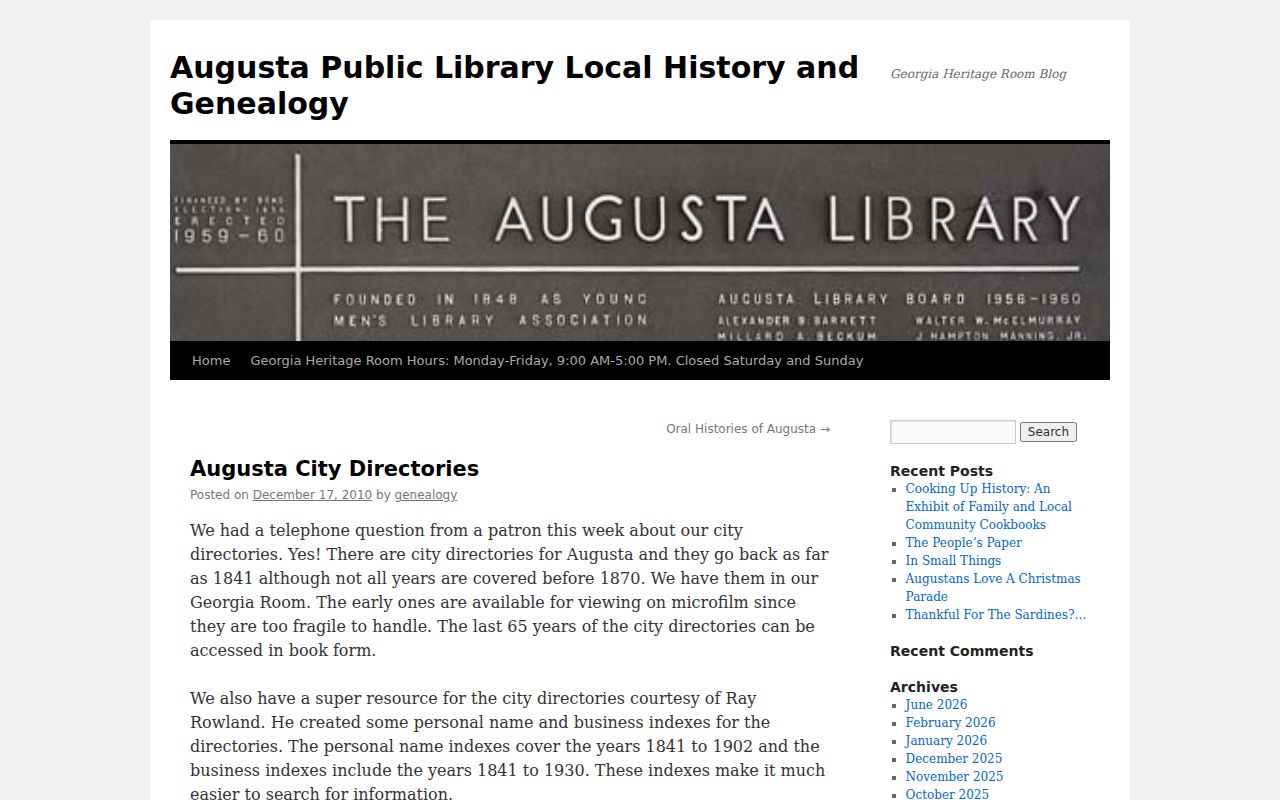
This local finding aid is the best first stop for deciding whether an edition is available as a book, microfilm, or indexed title.
Augusta City Directory Years Surviving
The first identified volume is The Augusta Directory and City Advertiser for 1841. Surviving pre-1880 editions include 1841, 1859, 1861, 1865-66, 1867, 1872, 1874-75, and 1879. Directories become much denser after 1880. Ray Rowland's personal-name indexes cover 1841 through 1902, while his business indexes extend through 1930. Alice O. Walker's catalog describes the Augusta volumes from 1841 through 1939.
| Period | Directory milestone |
|---|---|
| 1841 | First identified Augusta city directory |
| 1859-1879 | Sparse surviving early sequence |
| 1872 | African American residents begin appearing in the commercial listings |
| 1880 onward | Denser runs and a later two-volume AGS name index for 1880-1901 |
| 1930 | End of the published business-index span |
The timeline reflects what survives and has been indexed, not a claim that every household appeared. Commercial canvassing, skipped editions, spelling variants, and exclusion all create false gaps.
Use Augusta's Georgia Heritage Room
The Georgia Heritage Room is on the third floor of Headquarters Library at 823 Telfair Street. Current collection hours are Monday through Thursday, 10 a.m. to 5 p.m., and Friday, 10 a.m. to 4 p.m. Materials do not circulate. Researchers may take notes and photographs, which is useful when a fragile book must remain on microfilm or in supervised use.
Black-and-white copies cost $0.25 and color copies cost $2. Remote help is unusually practical: a $5 ready-reference request can check one name in one to five directory years or run an obituary or newspaper lookup. Call 706-826-1511 when a trip is not possible. That service is a real access channel, not merely a fallback.
The library's online resource list identifies the remote and in-library research options shown here.
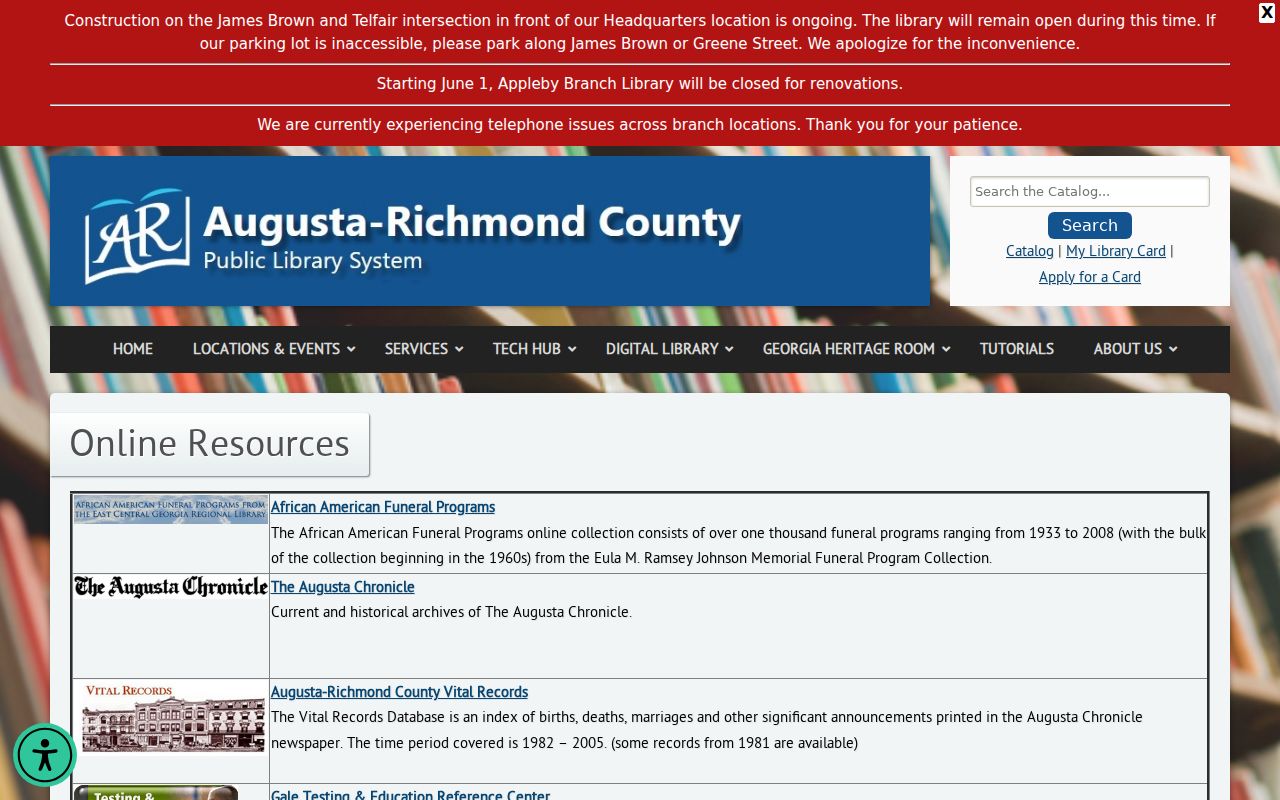
Ancestry Library Edition is available in the library, HeritageQuest can be reached through GALILEO by eligible PINES cardholders, and FamilySearch Affiliate access is offered in the Georgia Room.
Decode an Augusta Directory Entry
An entry must be read in the context of its own edition. Augusta listings can contain a surname and given name or initials, a spouse in parentheses, occupation, employer or business, home address, and sometimes an owner or renter mark. A widow notation may name the deceased spouse. Business-classified sections group trades and can identify owners or managers missed in a simple surname scan.
| Name | Indexed surname and given name or initials; test spelling variants |
|---|---|
| Spouse or widow note | Relationship clue that may separate same-name residents |
| Occupation or business | Trade, firm, owner, or manager as printed |
| Address | House number and street at the edition's publication date |
| Owner or renter symbol | Volume-specific mark that must be checked against the key |
Never assume that an abbreviation has one meaning across all years. Photograph the title page, publication year, abbreviation key, and full entry together so later notes remain auditable.
- Criss-cross directory
- A later arrangement that lists streets and house numbers, allowing an address-first search.
- Householder index
- An index intended to lead from a named household head to the full listing.
- Abbreviation key
- The edition's legend for compressed terms and symbols. It controls how marks in that volume should be read.
Augusta's 1872 Directory Divide
The library's history notes that African American residents begin appearing in the 1872 Augusta directory. That makes 1872 an important boundary in representation, not the start of Black residence in the city. Absence from an earlier commercial volume cannot be treated as proof that a person was absent from Augusta.
Freedman's Bank Augusta branch signature registers from November 1870 through June 1872 help address that bias. Census schedules, church records, newspapers, cemetery indexes, and later funeral programs also recover people whom publishers omitted. The ARCPLS African American Funeral Programs collection contains more than 1,000 digitized programs dated from 1933 through 2008, with most after the 1960s.
Local context matters by neighborhood. Laney Walker-Bethlehem and Paine College research often needs Black newspapers, school sources, church records, and funeral programs beside the city directory. A missing alphabetical listing is the start of a broader search.
Augusta Directories Beyond the Shelf
No verified public website holds every Augusta city directory as a complete image run. Digital companions still make a major difference. The UGA Map and Government Information Library city-directory collection documents holdings and access notes.
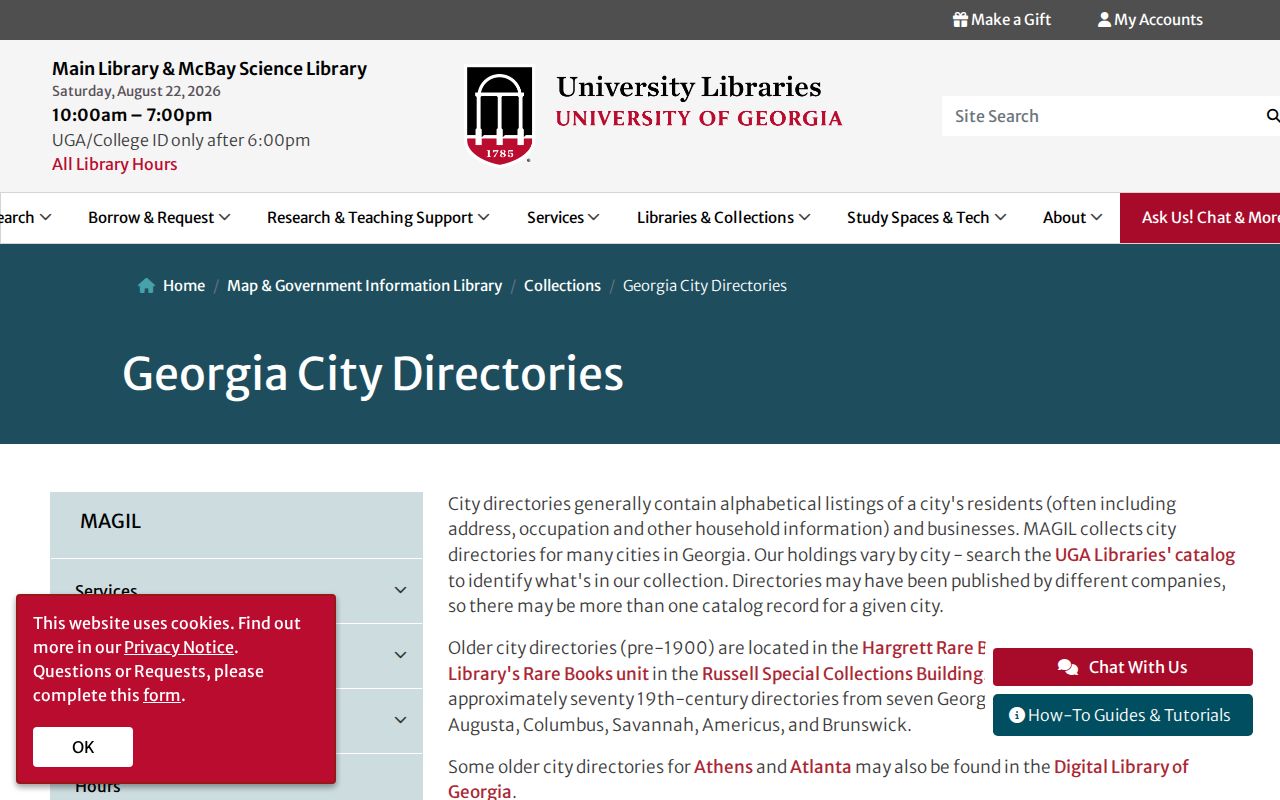
The UGA source helps locate directory material outside Augusta and supports a planned archive visit instead of a blind search.
ARCPLS also provides a vital-announcement database covering mainly 1982 through 2005, with some 1981 entries. It indexes births, deaths, marriages, and other announcements, but it is not a civil certificate. The Augusta Chronicle archive begins in 1792, while digitized Augusta Focus, Augusta Herald, and Augusta News-Review titles add community coverage.
Telephone books cover subscribers rather than all adults. Reverse sections can identify a listed subscriber at an address, yet they do not establish ownership or name everyone in the home.
Augusta's Fire Records Join Directories
The Great Augusta Fire of March 1916 changed the physical city. A stronger building code followed, and the 1917 Sanborn maps show fireproof rebuilding on the 700 block of Broad Street. City directories can identify listed people and firms before or after that shift, but they cannot explain the structure itself.
In 2024, the Digital Library of Georgia digitized one-of-a-kind Augusta Fire Department ledgers. The ARCPLS digitization announcement introduces the collection shown below.
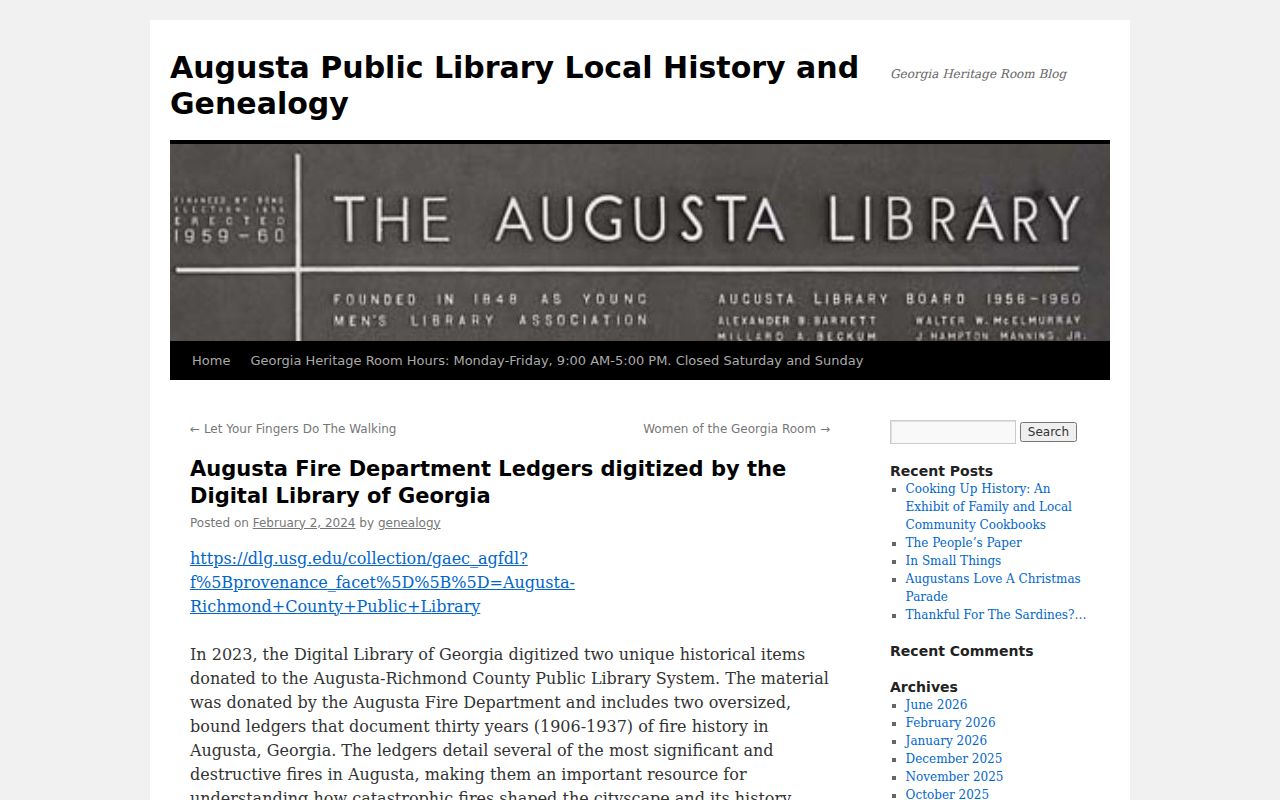
Together, a dated directory, the 1917 map, building-code history, and an incident ledger can explain why a household or business entry changed after the fire.
Trace Family Through Augusta Directories
Use each Augusta city directory as dated evidence. A name that vanishes may have moved, died, changed spelling, or been missed by the publisher. Search one edition before and after the gap, then move into another record type.
- Begin with the personal-name index, then open the full entry. Save the edition year, page, spelling, occupation, spouse notation, address, and abbreviation key.
- Follow the same surname and address through adjacent directory years. Test initials, former surnames, and common misspellings.
- Where an address section exists, reverse the search and inspect other listed people at that house or nearby addresses.
- Pair the directory with the nearest public census. Federal population schedules are now public through 1950 under the 72-year release rule.
- Check newspaper notices, funeral programs, cemetery indexes, deeds, and Probate Court records to explain a move, death, or heir relationship.
Enumeration shows a household on one census date. A directory shows a publisher's listing at another point. Neither proves uninterrupted residence. If the current question is keyed to a modern parcel, shift to the Augusta street directory workflow after the historical identity is clear.
Note: Keep the printed year attached to every Augusta listing so a historical address is never presented as a current residence.